
Learn how to choose the right T-shirt size online using measurements, size charts, fit types, fabric, and practical tips to find a comfortable and better-fitting T-shirt.
How to Choose the Right T-Shirt Size Online: A Complete Fit Guide
Buying a T-shirt online can be convenient, but choosing the right size is not always as simple as selecting Small, Medium, Large, or XL. Different clothing brands can use different measurements, and the same size label may fit differently depending on the cut, fabric, and style of the T-shirt.
A T-shirt that looks great in a product photo may feel too tight around the chest, too wide around the waist, or too long after it arrives. This is why checking the size chart and understanding the fit is more useful than relying only on your usual size.
The good news is that you don’t need to visit a store to make a better size decision. With a flexible measuring tape, a well-fitting T-shirt, and the manufacturer’s size chart, you can make a much more informed choice from home.
This guide explains how to choose the right T-shirt size online, what measurements to check, how different fits affect sizing, and what to consider before placing an order.
Quick Answer
To choose the right T-shirt size online, measure your chest, shoulders, and T-shirt length, then compare those measurements with the brand’s size chart. Also check whether the T-shirt is Slim Fit, Regular Fit, Relaxed Fit, or Oversized, because the same labelled size can have a very different shape depending on the fit.
Why T-Shirt Sizes Are Not Always the Same
One of the biggest mistakes shoppers make is assuming that a Medium T-shirt will have identical measurements across all brands. It won’t necessarily.
A brand may design its Medium T-shirt with a wider chest, longer body, shorter sleeves, or a different shoulder width than another brand. The difference can become even more noticeable when comparing Slim Fit and Oversized T-shirts.
For this reason, a size label should be treated as a starting point rather than an exact measurement.
Before ordering, always check the actual measurements provided by the seller.
Read This Article- How to Choose the Right Jeans Fit for Your Body Type
The Most Important T-Shirt Measurements
You don’t need dozens of measurements to choose a T-shirt. A few key measurements can provide a very useful reference.
1. Chest
Chest measurement is one of the most important measurements when choosing a T-shirt.
If the chest is too small, the shirt can feel restrictive and may pull around the buttons, seams, or sleeves. If it is excessively large, the garment may appear unnecessarily loose.
When checking a size chart, look for either:
- Body chest measurement, or
- Garment chest measurement
These are not the same thing, so make sure you understand which one the brand is showing.
2. Shoulder Width
Shoulder width affects how naturally a T-shirt sits on your upper body.
If the shoulder measurement is too narrow, the sleeves can pull upwards and the garment may feel restrictive. If it’s too wide, the shoulder seam may sit far beyond your natural shoulder.
For a traditional T-shirt, the shoulder seam usually sits close to the end of your shoulder. Oversized styles may intentionally extend beyond it.
3. T-Shirt Length
Length is particularly important when shopping online.
A T-shirt can have the correct chest measurement but still feel uncomfortable if the body is too short or too long.
Check the length from the highest point near the shoulder down to the bottom hem, following the measurement method used by the seller.
Your preferred length also depends on the style. A standard everyday T-shirt usually has a different length from an oversized or longline T-shirt.
4. Sleeve Length
Sleeve length can affect the overall appearance of a T-shirt.
Short sleeves may finish higher on the upper arm, while relaxed or oversized designs often have longer sleeves.
If sleeve length matters to you, compare it with a T-shirt you already own and like.
Body Measurements vs Garment Measurements
This is one of the most important things to understand when shopping online.
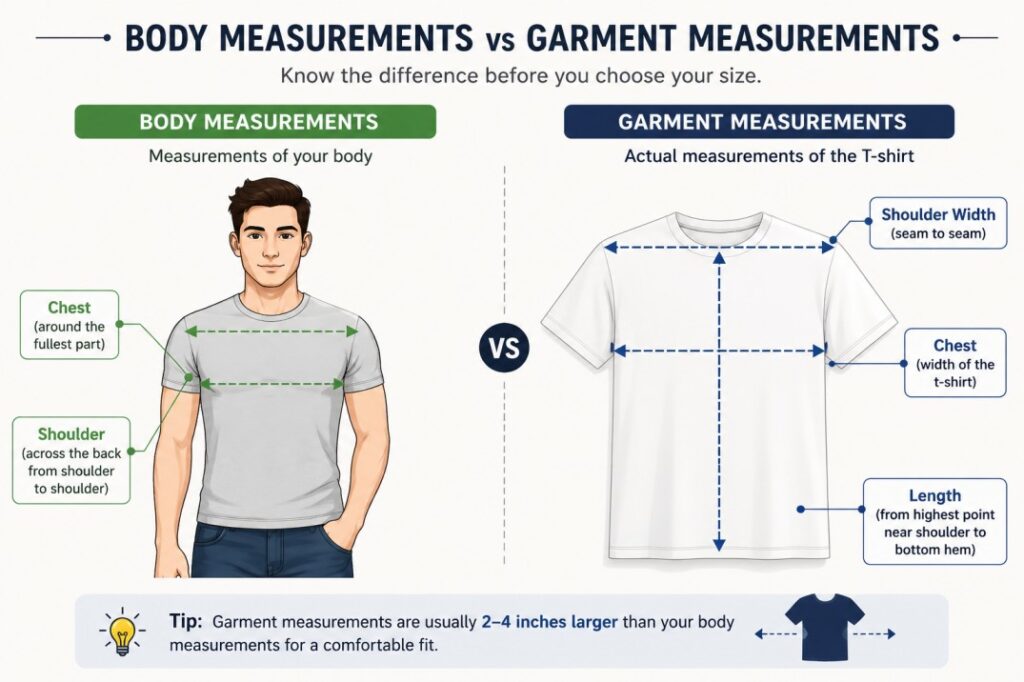
A body measurement describes the size of your body.
A garment measurement describes the actual dimensions of the T-shirt.
For example, a T-shirt designed for a particular chest size will normally need some additional room so that you can move comfortably. Therefore, the garment’s chest measurement may be larger than your body’s chest measurement.
Don’t automatically choose the size with a garment measurement identical to your body measurement.
Instead, follow the brand’s instructions and compare the chart with the type of measurement it provides.
How to Measure Your Body for a T-Shirt
You can take your measurements at home in just a few minutes.
1: Wear Light Clothing: Wear a thin T-shirt or similar clothing. Avoid measuring over a thick sweatshirt or jacket.
2: Measure Your Chest: Wrap a flexible measuring tape around the fullest part of your chest. Keep the tape level and comfortably snug. Don’t pull it tightly or hold your breath.
3: Measure Your Shoulders: Measure across the back from one shoulder point to the other. If possible, ask someone to help you with this measurement for better accuracy.
4: Measure Your Preferred T-Shirt: If you already own a T-shirt that fits you perfectly, measure that garment as well.
This can be extremely useful because you already know how that particular garment feels on your body.
How to Measure a T-Shirt You Already Own
A well-fitting T-shirt can act as a useful reference when shopping online.
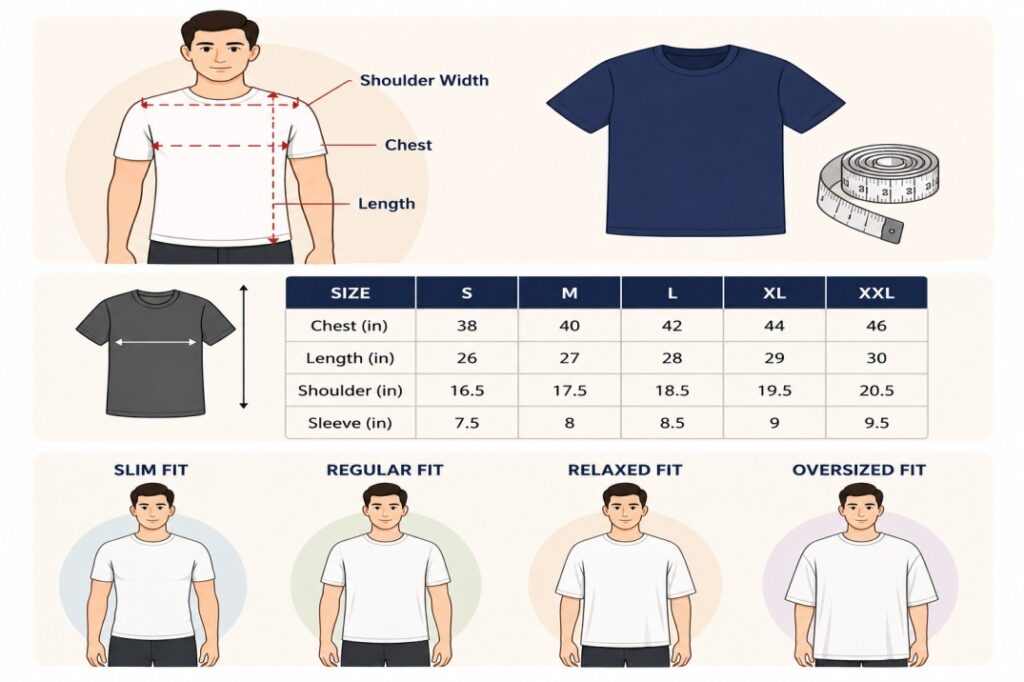
Lay the T-shirt flat on a clean surface and smooth out major wrinkles without stretching the fabric. Then measure:
- Chest width
- Shoulder width
- Body length
- Sleeve length
If the size chart of the new T-shirt provides garment measurements, comparing the two garments can make the decision easier.
Remember that measuring methods can differ between brands, so use the seller’s measurement instructions whenever available.
Understanding Different T-Shirt Fits
Size and fit are two different things. You can buy the correct size and still dislike the T-shirt if the fit doesn’t match your preference.
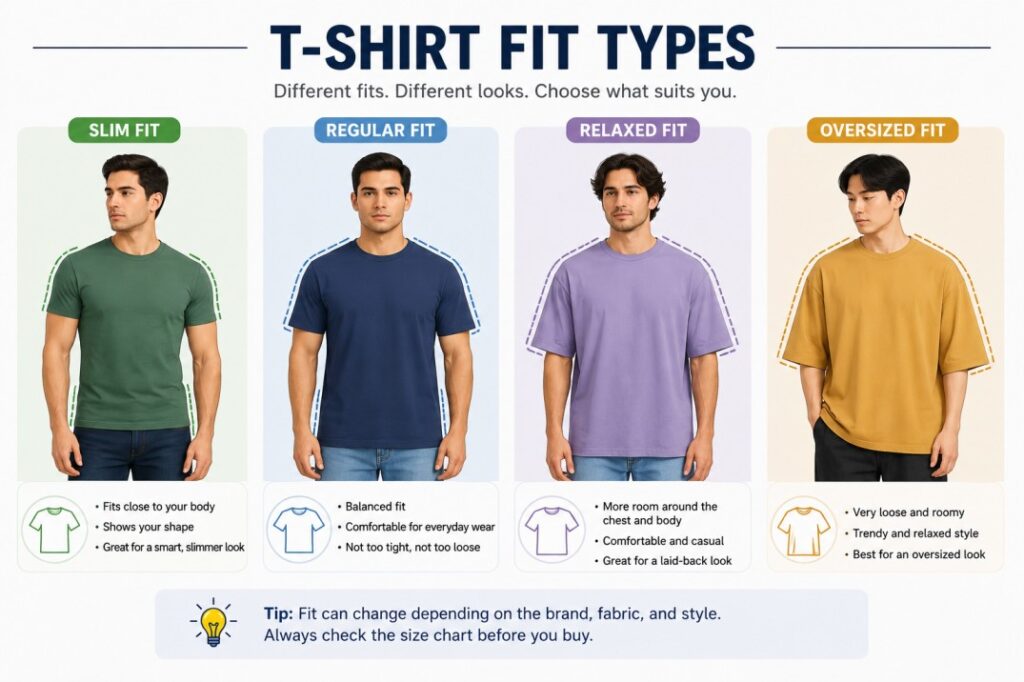
Slim Fit
Slim Fit T-shirts are cut closer to the body. They usually have:
- Narrower chest
- More fitted waist
- Shorter or more fitted sleeves
- A cleaner silhouette
Slim Fit can work well for people who prefer a structured appearance.
However, if you prefer plenty of movement around the chest and waist, Regular or Relaxed Fit may be more comfortable.
Regular Fit
Regular Fit provides a balanced amount of room without looking excessively loose. It is a practical choice for:
- Everyday wear
- Casual outfits
- Layering
- General use
For shoppers who aren’t sure which style to choose, Regular Fit can be a useful starting point.
Relaxed Fit
Relaxed Fit provides additional room through the body. It can be useful for:
- Casual wear
- Travel
- Everyday comfort
- Warm weather
- People who prefer a less restrictive silhouette
Relaxed Fit doesn’t necessarily mean oversized. It simply provides a roomier cut than a traditional fit.
Oversized Fit
Oversized T-shirts are intentionally larger and often have:
- Dropped shoulders
- Wider chest
- Longer sleeves
- Longer body
- Loose overall silhouette
Don’t automatically size up to create an oversized look if the product is already designed as Oversized Fit.
If you buy an Oversized T-shirt and then size up again, the result may be considerably larger than expected.
T-Shirt Fit Comparison
| Fit Type | Overall Shape | Comfort | Appearance |
|---|---|---|---|
| Slim Fit | Close to body | Moderate to good | Clean and fitted |
| Regular Fit | Balanced | Very good | Classic |
| Relaxed Fit | Roomier | Excellent | Casual |
| Oversized Fit | Very loose | Excellent | Modern and streetwear-inspired |
How Fabric Can Affect T-Shirt Size
Fabric composition also matters.
A T-shirt made from a stretchy blend may feel different from a rigid fabric with little or no stretch, even when the measurements appear similar.
Cotton
Cotton is popular for everyday T-shirts because of its comfortable feel and breathability.
However, some cotton garments may shrink depending on the fabric, finishing process, and washing method.
Polyester
Polyester is often used in sportswear and performance clothing because it is durable and generally dries quickly.
Cotton-Polyester Blends
Blended fabrics can combine characteristics from both fibres.
Elastane or Spandex
Small amounts of stretch fibre can make a T-shirt more flexible and easier to move in.
When buying online, don’t just look at the percentage of cotton. Read the complete fabric composition.
Should You Size Up or Size Down?
There is no universal rule. Your decision should depend on:
- Your measurements
- The brand’s size chart
- The fit type
- Fabric stretch
- Your personal preference
If you’re between two sizes, carefully read the product’s fit information and reviews.
For a fitted style, the smaller option may sometimes create a closer silhouette, while a larger option may provide more comfort. However, the manufacturer’s measurements should always take priority over a general rule.
What to Look for in Customer Reviews
Customer reviews can provide useful information that isn’t always visible in product photos. Look for comments about:
- Whether the T-shirt runs small
- Whether it runs large
- Actual fabric feel
- Shrinkage after washing
- Sleeve length
- Body length
- Overall comfort
Reviews that include specific details are usually more useful than comments that simply say “good product.”
If multiple customers mention the same sizing issue, consider that information before ordering.
Don’t Judge Size by Height Alone
Height can influence how a T-shirt looks, but it isn’t enough to determine the correct size. Two people with the same height can have very different:
- Chest measurements
- Shoulder widths
- Waist measurements
- Arm lengths
- Body proportions
Your measurements and the garment’s cut are more useful than height alone.
Common Mistakes When Buying T-Shirts Online
- Choosing Your Usual Size Without Checking the Chart: Your usual size may vary between brands.
- Ignoring the Fit Description: Slim, Regular, Relaxed, and Oversized are not interchangeable.
- Measuring Over Thick Clothes: This can produce inaccurate measurements.
- Confusing Garment and Body Measurements: Always determine which type of measurement the seller is showing.
- Ignoring Shrinkage: Some fabrics can change slightly after washing.
- Buying Based Only on Product Photos: Photography, lighting, posing, and styling can make a garment appear different from its actual fit.
A Simple T-Shirt Size Checklist
Before clicking Buy, check these seven things:
- Chest measurement
- Shoulder width
- T-shirt length
- Fit type
- Fabric composition
- Customer reviews
- Return or exchange policy
If all seven look suitable, you have a much stronger basis for choosing your size.
Example: Choosing Between Medium and Large
Suppose you normally wear Medium but you’re considering a new T-shirt online. Don’t immediately choose Medium.
Instead:
Step 1: Measure your chest.
Step 2: Check the brand’s size chart.
Step 3: Check whether the T-shirt is Slim, Regular, Relaxed, or Oversized.
Step 4: Compare the garment’s measurements with a T-shirt you already own.
Step 5: Read reviews for sizing comments.
This process is more reliable than assuming your normal size will always fit.
How to Choose a T-Shirt for Different Uses
Everyday Wear: Regular Fit cotton T-shirts are versatile and easy to combine with jeans, chinos, shorts, and casual trousers.
Sports and Exercise: Look for fabrics designed to manage moisture and allow comfortable movement. Fit should provide freedom without excessive fabric getting in the way.
Layering: A closer-fitting T-shirt can work well underneath shirts, jackets, or sweaters because it creates less bulk.
Casual Streetwear: Relaxed and Oversized fits can create a more contemporary silhouette, particularly when paired with loose or straight-leg bottoms.
Hot Weather: Prioritise breathable fabrics, comfortable cuts, and lightweight construction.
How to Care for a New T-Shirt After Buying
Choosing the correct size is only the beginning. Proper care can help preserve the fit and appearance.
Always check the garment’s care label before washing. Some useful habits include:
- Follow the recommended washing temperature.
- Avoid unnecessary high heat.
- Use appropriate washing cycles.
- Don’t overload the washing machine.
- Follow drying instructions.
- Store clean T-shirts properly.
Correct care can help reduce premature fading, stretching, and fabric damage.
Frequently Asked Questions
How do I know what T-shirt size to buy online?
Measure your chest and compare it with the manufacturer’s size chart. Also check shoulder width, length, and the T-shirt’s fit type.
Should I buy one size bigger for comfort?
Not necessarily. If the T-shirt is already designed as Relaxed or Oversized, sizing up may make it much larger than expected.
Is Medium the same size everywhere?
No. Clothing measurements can vary between brands and even between different product styles from the same brand.
How should a T-shirt fit around the shoulders?
For a conventional fit, the shoulder seam should generally sit close to the natural shoulder edge. Some oversized styles intentionally use dropped shoulders.
How much room should a T-shirt have around the chest?
There should be enough room to move comfortably without excessive pulling or unwanted tightness. The ideal amount depends on the fit style and personal preference.
Is Slim Fit smaller than Regular Fit?
Slim Fit is generally cut closer to the body, but the labelled size itself isn’t necessarily a smaller size. A Medium Slim Fit and Medium Regular Fit can have different garment dimensions.
Should I check the return policy before buying?
Yes. Even careful measurements cannot eliminate every sizing uncertainty, so understanding the seller’s return or exchange policy is a sensible part of online shopping.
Final Thoughts
Choosing the right T-shirt size online doesn’t have to be a guessing game. The most reliable approach is to combine your own measurements with the manufacturer’s size chart, fit description, fabric information, and customer feedback.
Start by measuring your chest and shoulders, then compare those measurements with a T-shirt you already own and like. Pay particular attention to whether the new garment is Slim Fit, Regular Fit, Relaxed Fit, or Oversized because the cut can change the way the same labelled size feels and looks.
Most importantly, don’t assume that a size label such as Medium or Large has exactly the same meaning everywhere. Measurements are more useful than labels.
Taking a few extra minutes before ordering can help you find T-shirts that fit comfortably, look better, and are more likely to become regular parts of your wardrobe.